Thursday, November 1, 2012

Chapter 9
Money Makes Community?
© Eso A.B.

After the lessons of the Bacchanal (the name comes from the name of the Roman God of wine, thus perhaps meaning events at a debauch) were absorbed, the city was let survive without the intercession of laws. The tragedy of King Pentheus’ mother Evanka (Agave), who had cut off the head of her of son, became known far and wide. Fiery upturned trees, symbolizing a community uprooted by a city, the crevices between roots filled with pitch or resin, sometimes holding the head of a he-goat (trag in greek=he-goat),  rose in the sky as flaming torches at, both, summer and winter solstices.

The ritualistic ‘Bacchanal’ that was celebrated at the foot of the tree or pole that held the roots came to be called a tragedy or “Theatre of ‘sacrificial violence’” http://en.wikipedia.org/wiki/Ren%C3%A9 Girard . Many hundred years of peace followed. Playwright Euripides most likely wrote the tragedy as a reminder what happens when the effects of reality wear off and violence begins to reemerge.

Dionysus, who had escaped the riot police of Thebes, became a theatre director and came to visit Thebes every year at Midsummer. The ritual-play reminded everyone of the bloody event that had cost the citizens of Thebes their sanity and King Pentheus his head and why it had happened. Cities all over the world learned from the event.

This is not to say that a ‘sacrificial event’ is everywhere the same. As we may remember (see Ch. 1), Jesus the Bogomil died in Constantinople as a result of being pushed into a roaring pit of fire. In Latvia, one of its kings was captured by an enemy and killed by the heat of a red hot iron crown that was put on his head. This is why the Latvians still light a ‘live’ fire and raise it into the air on Missummer’s Eve Festival of Dionysus-Yahnyi.

Alas, the Latvians no longer remember that the wood baskets that they raise were once the roots of an upturned tree. Nevertheless, we may guess that the reason goes back to Euripides’  “The Bacchae”, and the daring and—at the horrific—ritual invented by the King’s mother to detract everyone’s attention from her own bloody act. Indeed, her act, the invention of the ritual in which she places her son’s head among the roots of the tree, then raises the resin coated roots and stem, burning, into the sky as if it were the sun, may be viewed as the first act of theatre and tragedy.

While today the tradition of Midsummer’s Eve and Dionysian Festival—along with self-sacrifice as a communal custom—is long dead and gone, and organizers of Midsummer events have substituted the long ago community religious ritual with conventional entertainment by pop music and (at Stonhenge) with pseudo Celtic priests doing nothing, a writer’s imagination may, nevertheless, evoke the event with its religious meaning intact. Thus, the following is for the reader’s imagination, his-her own theatre in the head:

Imagine that the public brings to the Stonehenge a tree uprooted by a storm and with its roots still intact. The roots are then covered with tar, the tar is put to fire, and the tree is raised (upside down and with appropriate pulleys) in the air. After the roots have burnt and the fire has exhausted itself, the trunk of the tree is lowered; the burnt end of the stump is severed from the trunk and carried to a place of honor, where it stands until the arrival of the winter solstice.

Sadly, no one in Europe remembers today remembers that to keep the community strong, the head of the community once had to sacrifice his-her head to prove his-her right to have been its leader.

Today the pseudo heads of European governments receive upon retirement a political promotion to a backbench EU office in Brussels, or a chair on the advisory committee of a private company, or take a comfortable retirement check.*

Brussels, the capital city imposed on the European Union by European political elites, today suffers from a greater plague than Thebes ever did yesteryear. Brussels, built over the bodies of more than ten million Africans and over thousands of severed hands and legs of African children http://www.enotes.com/king-leopold-ii-congo-reference/king-leopold-ii-congo , all dead or crippled at the behest of King Leopold II of Belgium, is a city built with Money earned with more blood and pain than any other city in Europe. The urban monster—remade in the image of a seemingly kindly uncle from the EU and former premier of Belgium Herman van Rompuy—now proposes to compress European nations into a federated ‘black hole’ at Brussels, which is to play the role of a gravitational ‘attractant’ for the future of Europe. The key and lead word here is “global governance”. http://thenewamerican.com/world-news/europe/item/14041-bild --without ever asking the people of Europe what they think of it.

Nevertheless, in spite of the king’s head as an object of sacrifice, nothing ‘refreshes’ for the public its sense of awe so much as someone taking self-sacrifice for the sake of the community seriously http://www.bbc.co.uk/news/world-europe-22620143 . For all the masterful staging of the ‘reality’ of the EU, it remains (now that the Money for the rigging is gone and unlikely to return) an unconvincing spectacle https://www.youtube.com/watch?v=TcR1cG_LZSQ.

Without necessarily agreeing with England’s PM Cameron on all his arguments (at above link), I agree on his basic principle, i.e. no lesser sovereignty any European country than England, no lesser choice to determine its national life and culture, an in and out choice with regard to the union, and so on.

Unfortunately, self-sacrifice has been removed as an agent of good government ever since the Superego of God has been replaced by the Superego of Money. This phenomenon (of Money determining the kind of government rules over a people) has only recently begun to return the swing of the scales toward a balance, which, hopefully, will bring our planet out of  the danger zone.

Our planet lies in tatters as the living land is turned into a desert; as arguments for increased energy supplies dismiss the tattered nature of the planet as irrelevant to its survival; as city life continues to be praised even as the city increasingly resembles the environment of a desert; and as the trillions in dollars that have been borrowed against the future are already causing innumerable deaths among adults and children of the population at large; and as the community of humans has been shattered by the Superego of Money for well over a century already.

In a matter of only a few centuries (predominantly the 19th & 20th) attachments that held human beings together as a community were politically invalidated and eliminated as effectively as the European Union has been hoisted on the people of Europe. With the arrival of the 21st century so-called ‘atheism’ http://www.youtube.com/watch?v=Gx3_2lpvZKM , propelled by the inertia of Money (in spite of it becoming soon valueless) is advertising itself as irresponsibly as advertising that sells ‘sterile optimism’ in futuristic consumer items.

Chapter 8B
The Urban Trap
© Eso A.B.

On the green planet, the city is the third pole, on two of which ought to stand the wood.

The city, however, is the only pole that has been allowed to expand, cancer-like, to consume and destroy the wood and most of the wild life therein. Because the dying and destruction of the green is not yet complete and is awaiting completion, those still living there are living in a Purgatory known to no poet. We are at a circle known as ‘sinking Fukushimaplant #4’ http://www.infowars.com/ground-under-fukushima-unit-4-sinKing-structure-on-verge-of-complete-collapse/.

One may describe our Purgatory as a space a-buzz with news, rumors, filled with hyperactive anxiety, and random murders. Everyone who anticipates the future has his-her expectations focused on the coming ‘death blow’. This is to say, most everyone regards it a joke. Lady Gaga is more popular than ever, while Madonna’s politics is all about “Pussy Riot”(ing) at a church, and yet others are trying to preempt Purgatory of influence and are committing suicide to save Paradise. Like the Chinese leadership does to the Tibetans (repress them and force them to immolate themselves to be heard and seen), Western leaders do to their own in their own way.

No one is sure any longer what, besides children, is there to save. The news media presents its audience with news sufficiently insane for the audience to suspect double trouble ahead: the monsters, now draft age and trained in military camps, are coming home to serve.

Though the media is warning that humans ought not, nay, may not, give in to feelings of surrender and must maintain a ‘positive’ face in the face of imminent collapse, the ‘positive’ cancels and trumps ‘save’ by promoting cars that run on batteries charged with fuel produced by nuclear power plants in Russia, while teenage boys dream of driving ever faster.

Bread is slated to rise in price; those receiving food stamps are doubling in numbers; though government has no food reserves; and subsistence economy is soon likely to prove to be the only economy around. Unfortunately, there is no discussion as yet that politicians should start making token sacrifices (if they really want the office) by putting their little fingers under a laser blade, and pickling their pinkies in transparent jars placed on the speaker podiums of Beacon Hill, Capitol Hill, Kremlin, Heavenly City, Riga Parliament, on and on, for all to see.

Some think that such evidence of self-sacrifice is grotesque and obscene; nevertheless, it is common knowledge that in desperate times people demand and are swayed by desperate measures. History records a variety of such spontaneous and despondent measures. For the Aztecs the sun refused to rise until Nanauatzin (the Pimply Populist) jumped into the pit of fire. The King of the Bogomils, too, surrendered to fire. One of the oldest stories recorded is a play by the Greek playwright Euripedes. The play is called “Bacchae”, and it centers on the sacrifice of the King's head.

The story: The God Dionysus (God of sex and love, not fertility, appears in Thebes  wearing a wreath of oak leaves—as in most European cultures of archaic moment. Dionysus has many followers, especially among women. The tradition harks to the days when human beings lived in the wood, and Dionysus and the Sumerian Goddess of Love Ianna were guardians of life and sexual freedom. Dionysus was the women’s equivalent of “der Ewige Man” (the eternally manly) as centuries later the German poet Goethe created “das Ewig Weibliche”, the eternal womanly.

Dionysus quickly gathers about him the women of Thebes and leads them in a ‘bacchanal’, a kind of irregular line dance, out of the city and up the stony and woody slopes of Mt. Cithaeron. The purpose of the rite is to raise the Sun Goddess (just as the Aztecs had to), to get her to move out of a tall pine where she has got stuck during the morning's sunrise. Incidentally, all this occurs on Midsummer Eve.

This ‘bacchanal’ is no ordinary dance, but one that measures as a category 6 cyclone. As Dionysus’ followers advance through Thebes, the participants smash the windows of boutiques, break into wine cellars and smash expensive wine bottles, upturn the carts of vegetable traders and fish mongers, leaves of cannabis are burnt as incense. When they reach the outskirts of Thebes, the women catch the cackling and scattering chickens, and tear wing, leg, and head from body, and wave the bleeding and mutilated remains about their heads. Some women catch young calves and lambs and do the same with their body parts. They pull caches of cool butter from the water wells of peasants, smear themselves with butter, and threw themselves with ashes and fragments of coal from extinct fireplaces. Old women hump young women, and young women catch young goatherds or any man within reach, wrestle them to the ground and jerk them off. The men though horrified cannot help getting a hard-on. The ‘bacchantes’ leave behind them ground soaked with blood, moaning men crawling through all kinds of debris, and a sight reminiscent of chaos. All of this is because the Sun is standing still.

When Dionysus came to visit Thebes, all women joined him in the ‘bacchanal’. This was because the women, having been born in the wood, had become disillusioned with city life, felt they had been put in a prison. They were particularly incensed with men, because the King had imprisoned them in a quarter, which he called ‘Harem’ (a barn for washing sheep wool). Though the quarter had a swimming pool and the guards were eunuchs, the women still believed the place a prison. The 'Y(h)arem' bath house, beside where wool was bathed, was also where the King baptized the men whom he recruited to his cause by letting them enjoy 'a gang bang' at his and the women’s expense.

Dionysus had the entire screaming Yarem following him. All the women had blood flowing down their thighs. When the tornado or bacchanal was at its height, a great pit was dug at a ceremonial clearing in the wood and was filled with all kinds of fallen branches and piles of dry moss. Then a fire was put to it, and the women looked up to the tall pine just a little ways off, to where the Sun was supposed to be caught up in the branches. Instead of the Sun, what the women saw was King Pentheus of Thebes.

How did the King get there in place the Sun?

Briefly, the King had heard a rumor that the Bacchantes were a group of women indulging in pornographic displays of themselves. Starved of sexuality in his own urban atmosphere, he was more than curious to see the promised orgy. He had his guards secure for him a stand in the very tree the Sun was to have been stuck (of course, She was only a paper mache imitation), and had climbed up the tree from which to better see the events below.

When the Bacchantes saw that it was King Pentheus, all went wild. Some screamed, some stuck themselves with sharpened sticks of wood until they bled, some ran to the pine and began to climb up after Pentheus. Dionysus (in some countries he is known by the name of Ian, Ivan, Jean, John, etc.) calmly looked on and egged the women on, saying: "That bastard has stolen the Sun, get him!"

When the women had climbed the tree, they grabbed at King Pentheus legs and clothes and let themselves hang free. With all the weight pulling on him, Pentheus began to fall. He slid down the branches until he and the women fell into a yet larger crowd of women who had meanwhile gathered at the bottom of the tree.

One of the women known as Ianna, Evanka or Agave (the name depends on the ethnic origin of the story teller), ran up to the King, sat herself across his shoulders and seized his head. She twisted King Pentheus' head until she had twisted it right off his body.

Suddenly, Eveanna screamed: “Have mercy, John! Give us back our Sun!” she cried as she raised the King’s head into the air for everyone to see. Clots of blood slowly dripped to the ground from the edges of the severed neck.

As Eveanna screamed, the bacchantes reversed the direction of their wild dance and rushed, with Eveanna holding the King’s head before her as if it were some lantern for the market place and city square of Thebes again, where they threw the head into the outdoor toilet that stood at the centre of the square. All the women took turns sitting on the throne, which was called Cassiopeia, a name borrowed from a constellation of stars, generally located just above our heads, in the Milky Way.

When the ritual was done, Dionysus placed his finger between his lips and began ululating; the bacchantes joined him, then screamed:

“May the bleeding acorn burst forth the future wood!”

“Ayee! Ayee! Leego! Leego!” screamed the Bacchantes who had remained on the mountain. As of one mind, they closed around the corpse of King Pentheus. A few moments later one held up the King's lungs. Apparently the Bacchantes had torn them from the King’s rib cage. Perhaps it was at this time when, as the lungs deflated, they expelled a sound that later everyone insisted had moaned the word “ma-ma".

It was only now when the horns of the King’s body guard were heard as they guards rushed up Mt. Cithaeron to save the King.

“Sweet breasts of mother,” muttered Dionysus and stealthily disappeared among the trees in the grove that flanked the clearing.

Many years later a poet wrote a poem of a flee disappearing in the pubic hair of a lover and was never caught, because it managed to emerged on the side of the arse hole and jumped while the arse hung over the castle’s battlement.

Dionysus was not seen again until the Midsummer Festival of the following year.

However, the story is not yet finished.

Eventually, the shit-covered head of King Pentheus was retrieved from the toilet and washed. Only then the woman Eveanna, who was the mother of the King, discover that the head belonged to her son. Needless to say, she screamed and tore out all her hair. Many friends of her did likewise. Some say that out of these events was born what we know as the tragic theatre.

The great problem of the Bacchantes was that the Sun, which they had gone to the mountain to free from the pine tree, had not risen and was still nowhere to be seen. It was the mother of King Pentheus herself who came up with the solution.

She took the cleaned head, and led the Bacchantes back up Mt. Citheron once more. Once on the mountain and at the fire pit (it was still smoldering), the Bacchantes dug a hole around the pine until the tree fell of its own accord. Then the women shortened the trunk of the tree, and stuck what would have been its top into the pit of fire with its roots in the air. Then they set King Pentheus' head into a bucked filled with pitch of pine and set the bucked among the roots. Then they threw more wood into the pit, until another huge fire rose and consumed the roots of the tree and the bucket with the head of the King in it.

Henceforth, this event became part of a story of how the Sun, who up to that time had been a woman, became of male gender.

In the years that followed, the head of the King was often replaced by the head of a sacrificed billy goat. The bucket of pine pitch was replaced by a huge barrel of oak and, at least among the Latvians, it was then raised high into the sky. To this day, some continue to tell that this burning barrel represents the Sun set to move around the Earth again. Unfortunately, most Latvians have forgot the story, celebrate the Mid Summer Festival as a festival for getting drunk, then killing themselves driving at fast speed into ditches along the road of their now deforested land.
.......................

A late variant of the story tells that when Dionysus returned on the following year, he was followed by a group of men, all of who wore around their necks wreaths of oak leaves. When they came to Thebes, Dionysus and the men were met by a group of women with whips of birch in hand.

The women made the men, including Dionysus, stand along the bare slopes of Mt. Cithaeron. Then they and their children whipped the men’s bare legs until they screamed from pain. The women encouraged the men to scream ever louder and did not stop whipping them until their families or some merciful stranger came and planted in the place they were standing a sapling tree.

Sometimes, if no one interfered on behalf of the man and the man stood silent, a woman came and gnashed her teeth in his ear, and whispered in a chilling voice: “How would you like me to cut IT off with my teeth!?” Most men resumed their howling. That is how the Latvian wood began to be replanted.
Chapter 7
The Apocalypse Begins
© Eso A.B.

As noted in the Introduction (Ch. 1), Basil/Jesus the Bogomil was killed by fire and cremated (1118) in a pit dug on the grounds of the Hippodrome in Constantinople (now Istanbul).

Death by fire had its origins in the ‘fur’ or ‘pelt tax’ (no, no archeologists confirm this). Pressing the natives to deliver ever more furs (to Vikings and formerly holy Kings under attack by the invaders) involved threats to ‘primitive’ families and life, which, in turn, resulted in the natives turning to dehumanizing themselves enmasse, slaughtering animals, re: driving them over cliffs and using fire to act as the driving mechanism.

Needless to say, ‘primitive’ culture that had looked on all living beings as having equal value before the ‘Creator’ as themselves, soon became demoralized. Old bonds disintegrated. Because fires often burn out of control, a fire set to drive animals may result in loss of human life as well. The ‘primitive’ view that trees, especially old trees, are to be venerated as representatives of the spirits of ancestors disappeared, and with it respect for the wood as a sacred place, perhaps even Paradise. Fires leave terrible scars, and this fact in itself became, first, a tool to threaten with; second, a weapon of torture; third, a means of execution; fourth a way to disappear evidence of the past.

The campaigns against all things 'wild' that were not yet subject to self-appointed 'aliens' (ārāji) were led by the symbolic King Goldenlocks of the Haves (mentioned in the preceding two chapters). The 'Habs' or 'Havs', soon stood as symbols for forces which had learned the trick of living well by, first, demonizing animals, then by repressing fellow men, then by fighting wars for supremacy among themselves. In other words, the so-called "primitives" were none other than ordinary men and women living their lives in a manner they had done for tens of thousand years preceding the appearance of this ‘alien’/ārāji and so-called Arian social tumor.

Not surprisingly, this is the time when there began to spread a rumor that 'the end of days' was near. According the Russian mathematician and historian, “The Apocalypse” was written in 1486 in anticipation of The Apocalypse in 1492.*

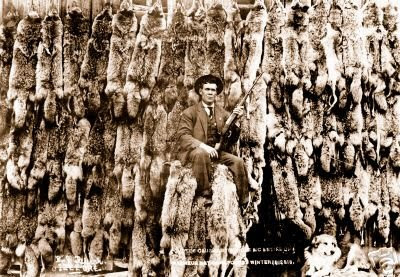
Much tax money was raised at the expense of the destruction of the great woods http://en.wikipedia.org/wiki/Forest_Finns . As the link says, the forest Finns “…had their origin in the Swedish colonization policy in Finland, a part of the Swedish Empire since the 13th century.” This was the pre-Apocalyptic time. In early times the wood covered much of our planet, whether one traveled north or south, east or west. After the forest and the life it supported destroyed, the empty space was replaced by arable land on which grain (rye) was raised http://www.monetary.org/a-brief-history-of-interest/2010/12 for profit. The rye also supported a life, but this form of life was largely limited to humans, who--no longer needing to share the bounty of the woods (berries, nuts, mushrooms) multiplied like rats in the barn of Swedish nobles. As we know, mice, rats, rabbits, sparrows, beavers, wolves https://blogger.googleusercontent.com/img/b/R29vZ2xl/AVvXsEgFL9buII6HFiG6YvPSG-0bp_V5N6CqUHwBdMizzqmq_h6GWvJ9dqjPUKvVWBOwuWRIyIYCDQqOxLnOWcibYNjziWJpfblhhp2pgikw9Fv0BvQiiUZCXK64hGGV3LVvjX0P_J79KqzrRWsK/s400/wolf+pelts.jpg , and later wild pigs were exterminate in huge numbers. As if their minds were genetically modified, the post-woods humans believed, with heart and soul, that desertification of planet Earth was their mission and crude lies sufficed to justify it. The native inhabitants of our planet, the people of the wood, were demoted to being ‘pagans’, a word that does not mean un-Christians, but sub-humans.

One of the 'alien' kings who was part of this destructive phenomenon and participated in holocausting human beings as well as the wood was King Alexius I of Byzantium. As the king’s implausibly (dehumanized) adoring daughter Anna Comnena notes in her book, “The Aleksiad” (Ch. 15), “…a huge fire was kindled….” Aside from being a spectacular event, apparently such spectacles were not an unusual sight. Huge logs filled a deep pit, and to make human sacrifice all the more spectacular and advertise the 'aliens' power (yes, Anna, was one of them) the Holy King Basil was thrown into “…the fire [of which] … the flames [were] rising and shooting out fiery sparks with a noise like thunder….” Such pits and piles of fire (whether they burned men or bricks does not matter) consumed not only Basil cum thousands of ordinary men and women, but changed the habitat of life on Earth for hundreds of thousands of years to come and eliminated many species of wild life, which planet Earth had come to support in the wood: a kingdom of a natural democracy.

Most of the cataclysmic weather changes in the world were not due to meteors hitting the earth or volcanic eruptions (as 'experts' and 'scientists' apologists now try to tell us), but were due to the abuse of the wood by an 'alien' class of human beings http://en.wikipedia.org/wiki/Great_Famine_of_1315%E2%80%931317 , who came to seize ‘secular leadership positions’ among ‘primitive’ religious societies. The rapid growth of human numbers at that time--as mentioned in the link--was due to the clearing of our planet of wild-life, the burning of the wood, and the institution of “human rights” such as had never been foreseen by the Creatrix. While ‘human rights’ in due course created a destructive civilization, originally it was meant only for princes and nobles.

While great changes took place on our planet beginning with the Miocene to Pliocene epochs, these changes were gradual rather than cataclysmic. Though the Miocene is a time when the Himalayan Uplift was at its most active and great changes took place in geography, the vibrations caused by earthquakes, did not make our planet less fertile or less populated by wild-life--except in limited locations. Indeed, the epoch is also noted for a transition from a warmer and moister climate to a cooler and dryer one. The Miocene began about 25 million years ago and ended 12 or 13 million years ago. The Pliocene, beginning and ending about 3 million years ago, ended in the Pleistocene epoch. Nevertheless, the changes were gradual enough for wild-life which in earlier epochs had lived in the wood to begin an evolutionary readjustment to a drier period on the savannah http://en.wikipedia.org/wiki/Savanna.

According to professor Robin Fox (“The Red Lamp of Incest”) “…a number of observers have pointed out that the multi-male system characterizes the primates in the forest, the woodland, and the tree savanna, while in the desert, the one-male system prevails.” (p. 118) This observation is an interesting one. Even if the main events happened millions of years ago, there are enough suggestions—judging from primate behavior in our own day—to think of not only the already given conclusion, but to imagine how a change from a life in the wood from times immemorial, led to the repression of the female of the primate species, when the mother and daughters were forced to move and live without the protection of the wood (symbolically represented by the apple and cherry trees).

How much greater the repression of social democracy among human beings, when during the last thousand years, they were thrust into a space where a desertified landscape predominated.

The ultimate steps, of course, led to an imprisonment in what some proudly, but mindlessly hail as the ‘urban environment’. Few note the sterility of this environment, though it should be obvious from the number of ‘creative designers’ who suck sand and  have no idea they themselves are of no more than some sand and cement and water mixed.

It does not take a military genius to realize that humans who live in a wood are better protected from their fellow humans by trees and leaf, than those who live in tin shacks or brick apartments are protected from the urban police policing the economy on behalf of ‘democracy’ dominated by banks. One only has to take a quick pedestrian look at Rio de Janeiro http://www.youtube.com/watch?v=1XC9TyIVZEg or Detroit http://www.youtube.com/watch?v=LTQFtNLvcl8.

Most of us have read the story of how in 9 AD a Roman general named Varus lost three armed legions to ‘primitive’ German tribesmen led by one Armenius in the Teutoburg Forest http://en.wikipedia.org/wiki/Teutoburg_Forest. Most of us know of guerilla warfare, much of which (at least in the past) took place because the guerillas were able to take advantage of tree cover in the cover.

One of the great wars of the latter half of the twentieth century, the Vietnam War http://en.wikipedia.org/wiki/Vietnam_War, found the self-destructive nation of United States of America (occupied by a wholly 'alienated' humankind) not only fighting Vietnam's tropical jungle, but losing the war due to the enduring nature of the Vietnam wood, which was rather literally breathing tropical steam supplied by the Mekong River. However, as the following clip shows, today the Mekong is being dried for the sake of ‘improving’ and bringing ‘progress’ to a culture of termites http://www.youtube.com/watch?v=trUCocM9FuA.

While Americans characterize the reason they fought the Vietnam War as an attempt to ‘contain evil’ communism, and claim to have won the war, there is reason for viewing the war as originating with an 'alien' (specifically European and American) urban civilization attempting to desertify the remaining landmass of our planet by eliminating its remaining woods and subjecting the majority of humankind to a minority of urban elites. In other words, the strategy of the American liberal capitalist social order may be characterized as self-destructive by means of subjecting humankind to a select group of psycho pathological secularists.

[In light of this annihilation of our planet, some readers may be interested to read my blog 20 (above), “The Despair of Stalin 1”. I argue that Stalin was not without his reasons. The persistence of capitalist aggression as expressed by the nature of American “desert” warfare is best seen in the current ‘craze’ to use unmanned planes or drones as attack vehicles on literally anyone who opposes http://www.youtube.com/watch?v=UdbV5J20mpw government agencies in service of banks and other mega-private interests.] The greatest danger to a new born in our age is not a miscarriage suffered by his-her mother, but an American military prick jerking himself off on death in a military van http://www.theatlantic.com/politics/archive/2012/12/the-guilty-conscience-of-a-drone-pilot-who-killed-a-child/266453/ in Texas or New Mexico.

Advertising itself as a ‘great democracy’, the advantage of America over other nations is/was traceable to its origins. It had none of the war debts and rapacious cultural legacies of derelict European kingdoms. Its founders were also enthusiastic supporter of an emerging ‘scientific’ but no less psycho pathological cultural leadership of 'aliens' among its own. Indeed, American leadership may have been among the most psychopathological of the cultures of the day, simply because the nation escaped being popularly labeled a ‘colonial power’ and could pretend being ‘an innocent’ bystander. [This is evidenced by the American choice of an ‘innocent’ President in the figure of Obama.] Nevertheless, the aim—as evidenced by the present distress of the American people—has all along been for a minority of elites to colonize the body of the people in the way the eggs of a parasitic wasp eat out the body of a caterpillar https://www.youtube.com/watch?v=vMG-LWyNcAs.

After a period of incubation, largely preoccupied with taking possession of a heretofore unoccupied continent (some would say—‘taking it away from the Indians’, especially during the 19th century), America unleashed itself upon the new continent and beyond.

It is of some interest that the psychopathology of ‘secular’ America’s ‘alien’ leadership manifests itself in a philosophy of ‘growth’ and as an end in itself. It is even more interesting that at this time ‘growth’ has come up against a ceiling. Even though there are many who insist that such a ceiling is only apparent and due to short-term financial problems bound to be temporary, the surface of planet Earth has become (no if and buts) an ecological disaster zone.

There are many who perceive our planet’s political problem as being more than just a disaster. With overextension and overreach of life support, the ‘9/11 event’ of 2001 illustrates to just what degree Americans have come to depend on ‘spectacle’ as a reminder of reality. Having survived more than a century sitting on the shoulders of war and bluff, the Western world no longer recognizes itself as having a relationship to the wood or the world as a wilderness. The closest thing to the ‘wild’ in the 21st century is to picture one’s self in a photo on the moon, arriving there at the cost of $50 million a ticket.

Anatoly Fomenko, “History: Fiction or Science”, vol. 1, p. 161.

Wednesday, October 31, 2012


Chapter 6
A Pinky for A Kingdom
© Eso A.B.
When Prince Goldenlocks first heard the croak of the frog, he froze as if caught in a piece of ice. As the son of the King of Havsburg, he had heard of conspiracies against his father, but he had never imagined that a conspiracy would be directed at him, while he was still at such a young age. He wondered—what else the frog might think to say?

To Prince Goldenlock’s mind, he had reasons to worry.

Neither he nor his sister were exemplars of ‘good’ children. They both were spoiled, lonely, and used to getting things done their way. Their biggest problem was that their governesses kept them from playing with children who were not born of other princes and princesses. According to rules of the Havsburgian Court, their friends had to be approved of by the King himself.

They also had no mother, who, when they asked about her, was said to be a “Blue Lady” who had been exiled to a far away island. According to rumors, she had died there while giving birth to a wooden doll with a long nose. This doll, too, had died at birth. At the time of its coming into the world, it had turned into blue smoke and then into pieces of charcoal. It was rumored that this still born brother was conceived by their mother, the Blue Lady, after she had become too friendly with a carpenter of the Havsburg castle, who had come to her apartment to build a coat rack.

However, nothing was said; no words escaped. Everyone present in the castle courtyard stood still. The only sound heard was the splash of the frog as it fell back into the well.

Prince Goldenlock’s mind remained uneasy however. He continued standing in the Court of the Havsburgia castle hardly daring to blink an eye. As he waited, the Prince recalled how he and his sister had presented their fancy toys to the children of the kitchen maids and servants hoping to bribe them to become their friends. King Goldenlocks had more than once wondered why so many of the expensive toys with which he presented his children became lost almost overnight and were later found in the servants’ quarters.

King Goldenlocks, however, was too haughty to demean himself by asking his tailor, cobbler, or chamber maids as to why the toys disappeared. He explained the phenomenon to himself as follows: all those who worked as his servants were on a government dole (the so-called “One hundred hours employment shift for the unemployed”, which program was sponsored by the European Union’s “Rompuy- Bilderberger Fund”), such people were, to his mind, naturally born with a talent for thievery. To make sure he was right, King Goldenlocks ordered the Minister of Domestic Affairs to investigate. The minister reported that, indeed, King Goldenlocks had it right, and all the children were born with ‘slavery’ genes spontaneously spawned by the bodies of alcoholic parents.
“I want the guilty one brought before me!” bellowed King Goldenlocks, as soon as his retainers had made sure that the frog could not be fished from the well and the gold in its stomach recovered. Somehow the king’s eyes fell on his son, and they would have nailed the Prince to his spot if they could have done it. Prince Goldenlocks looked so guilty.

“So it was you who betrayed me!” the king shouted without further ado. “To think that in less than twenty years you could be the next King of Havsburgia. What a shock and surprise! But don’t worry. You will suffer the punishment of traitors. You will be made an example of what happens to persons disloyal to the Crown.”

No one who that afternoon was at the Court of the Havsburgia Castle dared move or utter a sound. All anyone heard was the gravel under their feet. This did not stop the King from issuing orders which he believed were necessary for the maintenance of the Empire.

“I herewith order that young Prince Goldenlocks is taken to the Waldensee Wood. When there, he must be trussed (his hands and legs should be bent backward, tied), and he should then be put into the hollow core of an old tree. If the Prince is as witless in the wood as he has been at the Court of the Empire of Havsburgia, let him not be able to untie himself, and let him lie there until the wolves tear his buttocks into shreds and crows pick out his eyes. But if he does untie himself, let him become lost in the wood, and become food for the Queen of the Wood, the Monster Sphinx, http://www.youtube.com/watch?v=qQ-xh3kedW4&feature=related, she who loves to eat lost dogs, small rabbits, and small children!”

When Prince Goldenlocks heard his father lay such a curse on him, he suddenly lost fear and his limbs began to move as if on their own. His feet flew as if they were made to be wings and they flew for the wood.

As he ran, Prince Goldenlocks cried out such words as were instantly remembered by all who heard them, and which have since time become known around the world. Prince Goldenlocks cried: “There is but one place on Earth where everyone is equal, where everyone is ever fully employed, and where democracy rules—it is the wood!”

When the prince had reached the wood, he immediately called out: “Zhant! Zhant! Zhant! Help!”

The Prince was indeed in need of help. The moment Prince Goldenlocks had begun to run, the King’s retainers, too, began to pursue him. They were so close on the Prince’s heels that their hands were almost on his shoulders. In the next moment, they would almost have had him by his scruff.

Suddenly, the thick of the brush in front of the runners parted and from the  underbrush emerged a grunting herd of wild pigs. The pigs were a hundred in number. As if knowing why they had come, the herd of wild pigs parted and made a passageway for the prince to run through.

When the Prince was in their midst, the pigs closed their ranks. The retainers of King Goldenlocks were stopped short and could pursue the prince no further.

As the King’s retainers stood not knowing what to do, a young pig herd came through the ranks of the pigs. He was blowing a hazel whistle made from the hazel switch in his hand. The two items of hazelwood went together and the wild pigs had respect for that. They respected the whistle, because the herder always blew it when he had come on some fresh hoard of acorns, and they knew what a whack by the hazel stick meant. The pigs let their young herder through. In the quick of an eye, the pig herd stood before the king’s retainers.

“What’s your rush?” the pig herd asked. “It is my brother you are chasing.”

“Is that what he told you?” cried the king’s retainers. “Though he may be a prince, he is also a liar. He is not your brother. He is King Goldenlocks son. He is running away from home. The king is afraid that he will come to harm. We have orders to catch him and bring him home.”

It was the pig herd’s turn to look surprised. “I hear told,” he answered, “that if the prince is caught, he is to be trussed and tied, and left in a hollow of a tree to untie himself if he can. My father, King Greentop, does not like to see children are brought to the wood to be sacrificed. He and my mother, the Sphin, has sent me to stop you.”

“The Havsburgs are very nice kings,” answered the retainers defensively. “They would never do such a terrible thing as harm children. We, too, though unshaven, are fathers of children. Indeed, we have come to make a deal with you.”

“How’s that?” asked the pig herd.

“It is easy, John, ” answer the guards. “All you have to do is kill your dog, cut out his eye, and cut off his tongue, and bite off your little finger. In return, we will present you with Prince Goldenlocks’s clothes.”

“Hmm!” said John. “That sounds like an awful thing to do. That’s no bargain.”

“Don’t worry, John,” answered King Goldenlock’s retainers, “if you don’t like to do it, we will do it for you.” Having said that, one of the men speared Kranz, John’s dog, right through the heart and pinned him to a tree. The dog did not even give a yelp. In an instant the retainers had also cut out the dog’s eye and cut off its tongue. Then they turned to the pig herd and said:

“Now, John, you go behind that tree there and bite off your little finger. When you are done, wrap it in a leaf and bring it to us. We will take it to King Goldenlocks, and he will think it belongs to Prince Goldenlocks. He will be happy and give us a big reward, which will make us happy. You, too, will be happy, because after your wound heals you will be able to pretend that you are a prince.”

“That is against the First Commandment of the Wood: Never tell a lie or or you will have to chew the stem of a wild rose all day long,” protested John. He was shocked by the effrontery of King Goldenlocks retainers.

“That’s a commandment fit for a forest barbarian,” came the retainers answer. “If you don’t believe us, you can come with us and watch King Goldenlocks reward us with money that does not wrinkle.”

“I’ve heard that money has to be backed up by some value or it is worthless,” countered John.

“We are not worried that this will happen anytime soon,” came the reply. “Our empire stands on solid footing. If the King of the Wood knows how to balance himself standing on his head on a ball, in our empire our politicians float the ball on water and then headstand on it.”

“I would like to see that!” answered John, then went behind a big tree.

After a minute, John reappeared and handed King Goldenlocks’ retainers his pinky. As he gave them his pinky (it was still dripping blood), he said to  them: “When you give these things of flesh to King Goldenlocks, tell him that the day will come when I will ask them back.”

“John,” answered the guards, “we cannot do that. If we do, the Emperor of Havsburgia will chop off our heads.”

“Alright, keep it a secret,” answered John. “I’m glad to see that in spite of your rudeness, you are ready to hand me my new clothes. Before I accept them, however, there is one more thing I have to ask. With the clothes of a prince must come food fit for a prince. When you get back to the castle, tell Princess Goldenlocks that swine herd John would like to flavor his supper of boiled potatoes with caviar of Danube sturgeon.”

“The princess will be happy to oblige, we are sure,” answered the retainers and were off. They had seen the bushes move and heard the tell-tale croak of the Sphinx https://www.youtube.com/watch?v=gXkGSc6d0xQ

“Don’t forget!” called John behind them. Then he turned to Prince Goldenlocks, who was standing in his underwear:

“I am glad to meet you Prince Goldenlocks. Are you ready to exchange your clothes with me and take my place as a swine herd?”

A sus ordenes,” said Prince Goldenlocks in Spanish. It meant: “I am obliged to you.” He spoke both German and Spanish, because at that time the Havsburg Empire owned both Austria and Spain.

Even as the boys were conversing,  the brush parted and before them stood King Greentop. Beside him stood the Queen of the Wood, the Sphinx. She was a huge frog.


Chapter 5
The Wood and the Sphinx
© Eso A.B.

There is a Habsburgian fairy tale about a King Goldenlocks and his son, who was, not surprisingly, also called Prince Goldenlocks. The story is about how King Goldenlocks met and imprisoned King Greentop; and how Prince Goldenlocks, son of King Goldenlocks, liberated King Greentop.

Many years ago, one sunny autumn day, after the acorns had fallen to the ground and the wild pigs had fattened themselves on them for the winter months ahead, King Goldenlocks of the famed Habsburgs (aka ‘The Haveburgs; in German ‘haben’ means  ‘to have’) decided to go wild pig hunting. As is the wont of kings, King Goldenlocks did not go on the hunt alone, but invited the princes of Havsburg and Havsburg’s neighbors to join him.

As behooves a host, King Goldenlocks was the first to ride into the Waldensee (Sea of Trees) Wood. A little behind the king rode the king’s retainers.

The king rode along a well known road. On both sides of the road stood an honor guard of tall oaks with trunks thick enough to measure two meters (six feet) in diameter. Interspersed among the oaks were beech trees. The beach trees, too, grew many nutritious and tasty nuts.

After King Goldenlocks had entered the wood, his retainers started to blow their horns, and these were soon answered by the horns of the other hunting parties to their right and left. It was not long before the king came to a small clearing. The clearing was surrounded by large trees, some birches, some spruce. In the centre of the clearing was a small depression, which held within its bowl a small swamp. One could see that during the previous summer, the wild hogs had upturned the swamp mud and then had then laid themselves into the mud to cool their thick hides. This bathroom in the wood was known as a ‘hogs wallow’.

King Goldenlocks was surprised and taken aback to see on the other side of the clearing leaning against a gigantic oak tree, an unkempt and frightful looking giant. The giant looked almost like a man, except in place of hair, he had sprigs of oak leaves, and the soles of his shoes were made of thick pieces of oak bark, which were laced to his feet with pig tails and snakes. King Goldenlocks guessed that he had come upon the famed Giant of the Wood, the one everyone called King Greentop. This was the first time, either of the Kings met on their own.

King Goldenlocks hastened to assert himself and spoke first: “Hoa!” the King cried as his stallion, taking fright, reared and made ready to bolt.

“Hoa!” answered King Greentop. He reached out his arm and took hold of the stallion’s bridle. Then he asked: “Where goest Thou, King Goldenlocks?”

“I am going pig hunting,” answered King Goldenlocks. “Will you make way for me and my hunting party, and let go of my horse!?”

“Sure, King Goldenlocks,” answered King Greentop and let loose of the stallion’s briddle, “but first I would like to receive a present from you.”

“Are you asking me to pay you a bribe?” asked King Goldenlocks in a not very pleasant voice. “I would like to remind you that I, not you, am king of this wood.” Then as if relenting a little, he added: “Just out of curiosity, what is the present you want?”

“It is a small present,” answered King Greentop. “Since you want not only the flesh of my pigs, but also their souls, it is your little pinky that I want in exchange. You can bite it off and make a present of it to me. Here is a large leaf you can put it on.” King Greentop passed to King Goldenlocks a large, turned yellow, oak leaf.

“What an uncouth Giant you are,” replied King Goldenlocks and began to blow on his hunting horn as loudly as he knew how. His retainers joined him; and a loud braying of horns ensued.

King Greentop, however, was not moved. He cupped his hands over his mouth and called out in a voice that echoed from one end of the wood to the other: “King Goldenlocks, you and your party will not pass! If you want one of my wild boars, you must offer for him your bloody pinky.”

“Toot! Toot! Too! Toot! Toot!” went the horns of King Goldenlocks. Soon from all directions of the forest into the clearing rushed some of the most famous kings and princes of the time. At that time, Germany had so many princes that one could never count them all. Their horns, also, blared: “Toot! Toot! Too! Toot! Toot! ”

“Make way!” cried King Goldenlocks at King Greentop and brandished his long lance. Seeing that he was about to be attacked, King Greentop stepped behind the nearest tree, and with no further ado uprooted it, then threw the trunk with all the leaves into the clearing.

It took King Goldenlocks and his guests some time to extricate themselves from the swamp mud, branches, and leaves that they suddenly found themselves in the middle off. Some of them were unfortunate enough to have to limp around with broken legs and arms for some time, some cursed King Greentop for the rest of their lives.

Needless to say, a fierce battle ensued, which did not make much sense, except to mask the loss of further pretense for King Goldenlocks. It was fortunate for the King of Havsburg that his castle was not far away. During the battle, he sent many of his retainers to his barns and boathouses to bring him ever more bundles of rope. Evidently, he had a plan.

In the end, King Goldenlocks of Havsburg, captured the King of the Wood in a net of ropes, tied him to an uprooted tree, and had a hundred horses drag King Greentop, tree, and all to the yard of the Havsburg Castle. There, on short notice, a hundred smiths from the entire kingdom hammered together a special iron cage.  This is where King Goldenlocks then imprisoned King Greentop, upon which the chorus of the Castle of Havesburg sang “O Fortuna!” http://www.youtube.com/watch?v=GD3VsesSBsw

The Havsburg king’s plan was to keep King Greentop in the cage, and leave him without water until he dried up. When the Giant’s skin and bark began to peel, the emperor planned to announce a big festival, at which he would saw the limbs of the Giant into logs. The straighter logs he planned to burn in the fireplace of his cabinet, while those of irregular size would be dumped in a pit and the heat of the fire was going to be used to bake bricks with which the King of Havsburg planned to build himself the finest castle the world had ever seen.

After King Greentop was put in his prison, King Goldenlocks went to take a nap. Meantime, the King’s two young children, Princess and Prince Goldenlocks, who were not involved in the hunt in any way, went to play in the yard. Their toy was a rubber ball covered with gold leaf. They were told not to play with it, because gold leaf was expensive and did not adhere to rubber very well. Nevertheless, because they were children and did as children do, they played with the ball all the same.

Princess Goldenlocks kicked the ball first. She did not kick the ball to pass through the Court gate, where her brother had suggested she kick. The Princess aimed the ball for the well that stood at the end of the Court. Unfortunately, her foot was turned wrong and the ball seemed to have a mind of its own. It flew instead into the cage of King Greentop.

The Princess ran up to the cage and asked the Giant to return the ball.

“Of course, I will, my beautiful princess,” answered King Greentop, “but first, I would like you to give me a drink of water. I am dying of thirst.”

“I would, King Greentop,” answered Princess Goldenlocks, “but there is no rope or chain at the well to pull the water up with”. Indeed, no winch, or chain, or crock were to be seen anywhere near the well.”

“That’s alright,” sighed King Greentop, “maybe when the moon is full, it will come down for a drink, and leave its ladder behind. Meanwhile, a kiss from you will make me happy.”

Princess Goldenlocks allowed King Greentop to kiss her. He returned the golden ball to her.

Next it was the turn of Prince Goldenlocks to kick the ball. This time the ball also flew into the Giant’s cage.

This time King Greentop asked the Prince to open the gate of his prison for him.

Prince Goldenlocks did not want to do it, because he knew his father would be angry if he did. Besides, he was the next Havsburg in line to become king, which meant that he was supposed to agree with his father’s ways of ruling the kingdom.

King Greentop told the Prince not to worry. “If you let me out,” said King Greentop, “I will show you how you can balance on your head by balancing on a ball and your head.”

“But if it starts rolling, I will fall off it,” protested Prince Goldenlocks.  proud to show off how smart he was.

“Don’t worry,” answered King Greentop. “I will also teach you how you can wiggle your ears and make the ball move.”

After thinking the offer over, the temptation to know how to stand on his head on a ball and move forward by wiggling his ears, proved too great. Prince Goldenlocks was after all a boy, and he wished to stand out among Havsburgia’s princes. He therefore opened the prison door and let King Greentop leave.

“Thank you, children,” said King Greentop as he disappeared into the Waldensee Wood. “If you ever need my help, just run into the wood and call three times: ‘Giant! Giant! Giant!’  I will come and help you.”

When King Goldenlocks awakened from him nap, and came into the yard to look at his prisoner (he wanted to make sure that the capture had not been a dream), he was shocked to discover that King Greentop was no longer in his cage.

“Who let the prisoner out!” screamed Emperor Goldenlocks. “Who let the prisoner out? Who did this? I will pay thirty big pieces of gold to whoever tells me who did this!”

No one answered. It was as if no one had seen or knew anything. But then, unexpectedly, everyone heard the croak of a frog. The creature had crawled or jumped out of the well in ways no one knew how. It now sat on the rim of the well and was looking straight at the Emperor of Havsburg.

The frog croaked:“It was Prince Goldenlocks who opened the prison! Croak! Croak! Where is my gold?”

Emperor Goldenlocks had the thirty pieces of gold brought from the cellars of Havburg to him immediately. He immediately had it brought to the frog, who immediately swallowed it. Once the gold had sunk to the bottom of its belly, the frog became so heavy that it fell backward, back into the well.